Many homeowners and designers choose white oak flooring for its durability, versatile grain, and warm tones that complement both modern and traditional interiors; when you select white oak, you gain a stable, long-lasting surface that accepts stains evenly, enhances your home’s resale value, and adapts to varied decor, making it a practical, stylish foundation whether you prefer minimalist, rustic, or classic aesthetics.
The Characteristics of White Oak Flooring
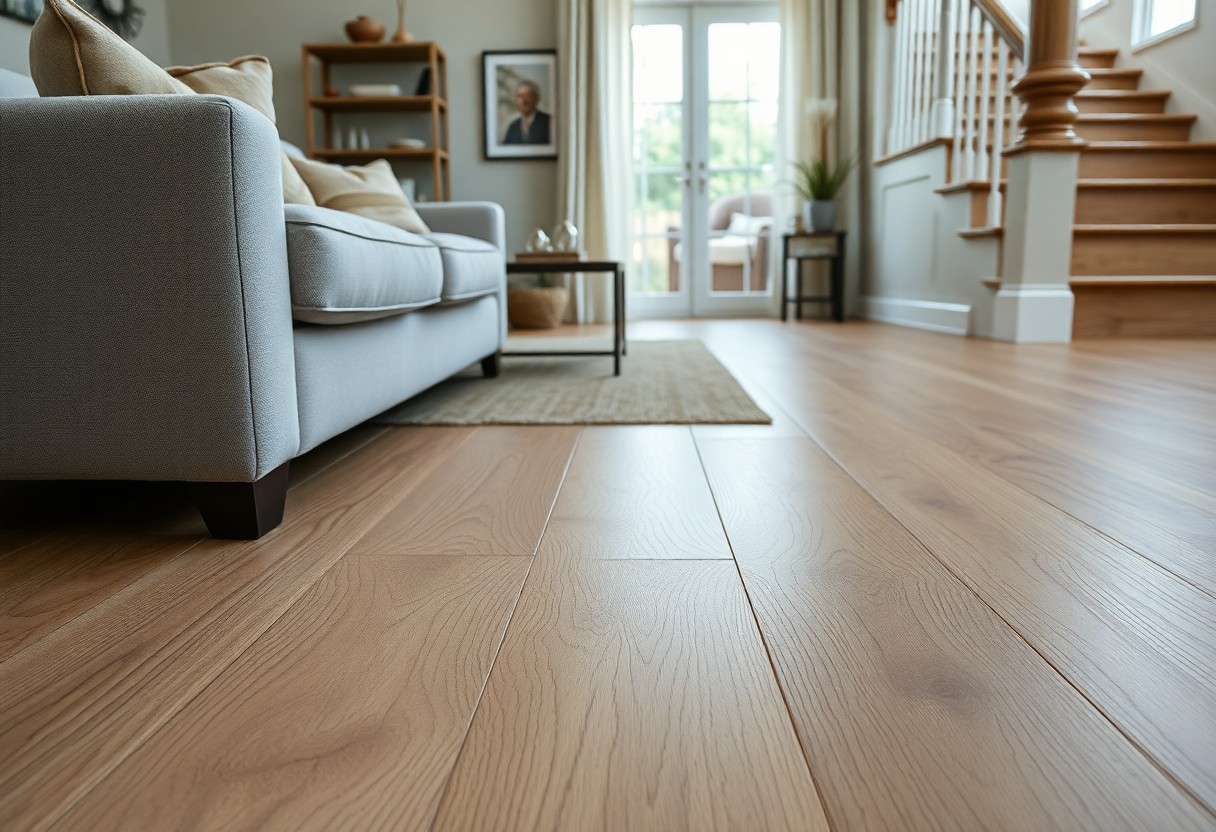
You get a wood that balances toughness and beauty: natural tyloses make white oak more water-resistant than red oak, its color ranges from pale beige to medium brown with olive undertones, and grain varies from straight to pronounced ray fleck in quarter-sawn boards. Typical plank widths run 3-7″ and lengths up to 8′, so you can choose narrow traditional or wide contemporary looks while benefiting from long-term dimensional stability in variable humidity.
Durability and Strength
Your white oak floors hold up: Janka hardness is about 1,360 lbf (vs. red oak ~1,290 lbf), resisting dents in high-traffic kitchens, entryways, and commercial spaces. Solid 3/4″ oak can be sanded roughly 4-6 times; engineered options with 3mm, 4mm, and 6mm wear layers typically allow about 1, 2, and 3 refinishes respectively. Tyloses also improve rot resistance, making white oak a practical choice for busy households and pet owners.
Aesthetic Appeal
You’ll appreciate white oak’s versatile palette: light to medium brown hues with subtle olive or amber casts, tight grain on plain-sawn boards, and dramatic ray fleck on quarter-sawn pieces favored in Arts & Crafts and contemporary designs. Finishes from matte oil to satin polyurethane and textures like wire-brushed or hand-scraped let you tailor the look, while its neutral warmth complements cool grays or classic creams.
Quarter-sawn white oak produces distinctive medullary ray patterns that read as silvery flecks under stain, often used to anchor mission-style interiors or upscale retail build-outs; for example, spec’ing 7″ wire-brushed planks in a loft creates an airy modern backdrop, whereas 3-4″ tumbled boards add character in rustic kitchens. You’ll also find white oak accepts gray, limed, and natural oil finishes evenly, though expect slight ambering with prolonged UV exposure over years.
Installation Methods
You choose between three main approaches: nail‑down, glue‑down, and floating. Nail‑down suits 3/4″ solid planks over plywood/OSB, glue‑down is typical for concrete slabs, and floating is best for engineered boards (3/8″-3/4″). Factor in subfloor type, moisture levels, plank width (3″-7″) and manufacturer acclimation requirements-most call for 48-72 hours-and plan a 3/8″-1/2″ perimeter expansion gap when installing.
Nail Down
You install solid white oak (usually 3/4″) by blind‑nailing or stapling with a pneumatic flooring nailer using 1.5″ cleats every 6-8″ along the tongue; stagger end joints at least 6″ and leave a 1/2″ expansion gap at walls. This method delivers a long‑lasting, refinishable surface that can be sanded multiple times and withstand high traffic in family homes and commercial spaces.
Floating Floors
You typically use engineered white oak (3/8″-1/2″) in click‑lock floating systems laid over a vapor barrier and underlayment, making them suitable for concrete slabs, existing tile, or low‑rise radiant heat. Acclimate boards 48-72 hours, keep a 3/8″ expansion gap, and avoid gluing locking seams unless specified by the manufacturer to allow natural movement.
You’ll notice floating installs are faster and more DIY‑friendly: a straightforward 400-800 sq ft room can often be completed in a day by an installer, depending on layout. Opt for thicker engineered assemblies (5/16″-1/2″) if you want a firmer feel and the possibility of one to two light refinishes later; choose underlayment to smooth minor subfloor variances and help reduce impact noise.
Maintenance and Care
Routine upkeep extends the life and appearance of your white oak: sweep or vacuum weekly with a soft‑brush attachment, wipe spills within 24 hours, and expect to refinish solid planks every 7-10 years under normal family use. Use felt furniture pads and area rugs in traffic zones to reduce wear; professional sanding removes deep scratches without altering the grain when performed correctly.
Cleaning Tips
For daily cleaning you should use a dry microfiber mop and a pH‑neutral cleaner diluted per manufacturer instructions; spot‑clean greasy marks with mild detergent and blot liquids immediately. Avoid steam mops and abrasive pads, which can lift fibers and dull finishes. If you have pets, keep a frequent grooming schedule to reduce shed hair and grit on the surface.
- Vacuum once a week using a hard‑floor setting or sweep daily to remove grit that scratches your finish.
- Use a microfiber mop and a pH‑neutral cleaner diluted 1:30 (one part cleaner to thirty parts water) when you damp‑mop.
- Avoid steam mops, bleach, or ammonia‑based products; they strip factory finishes and darken the wood if you use them.
- Assume that keeping indoor humidity between 35-55% prevents gapping and cupping; use a humidifier or dehumidifier as needed.
Preventative Measures
Protect high‑traffic areas with 3-5 mm‑thick rugs and use felt pads under furniture legs to prevent indentations; rotate rugs seasonally to equalize wear. Install door mats both outside and inside entryways to trap dirt-some installers report up to 40% less surface abrasion when mats are used consistently. Maintain a 1/4″ expansion gap at the perimeter to accommodate seasonal movement.
For busy homes you should schedule inspections every 6-12 months to check finish wear; plan a recoat when the finish has lost about 25-30% of its protective layer, which can extend full refinishing intervals by 2-4 years. Additionally, insist on soft‑caster wheels for rolling chairs, ban high heels on vulnerable areas, and keep humidity controls active during summer and winter to minimize dimensional changes.
Environmental Benefits
Beyond appearance, white oak flooring reduces long-term environmental impact through durability and responsible sourcing: you get boards that often last 50-100+ years with periodic refinishing, lowering replacement frequency. Quercus alba reaches maturity around 60-80 years, and selecting FSC- or PEFC-certified lumber supports regeneration and biodiversity. Reclaimed white oak preserves embodied carbon already in the wood while diverting material from landfill, so your flooring choice can meaningfully shrink your project’s lifecycle footprint.
Sustainability of White Oak
You benefit from a species widely available in eastern North America where selective harvesting and natural regeneration are common; choosing certified white oak (FSC/PEFC) assures legal sourcing and managed yield. Reclaimed planks from barns or industrial buildings extend service life beyond a century and offer documented provenance, reducing demand for new harvests. For your project, prioritizing certified or reclaimed white oak supports forest stewardship while delivering long-term performance.
Carbon Footprint Considerations
You should factor in embodied carbon: roughly 1 m³ of solid wood stores about 0.9 tonnes of CO2, so white oak flooring effectively sequesters carbon for the life of the product. Life-cycle assessments generally find hardwood flooring has lower cradle-to-gate emissions than PVC or many ceramic tiles when sourced regionally (within a few hundred kilometres). Choosing reclaimed or locally milled oak further minimizes transport and manufacturing emissions for your build.
Diving deeper, processing and transport drive much of the remaining footprint: kiln drying, milling, and long-distance shipping add emissions, while mills using biomass or renewable electricity cut processing impacts substantially. You can lower your flooring’s total CO2 by specifying air-dried or reclaimed boards, prioritizing local mills and installers, and selecting finishes with low VOCs and low embodied carbon. In retrofit projects, combining reclaimed white oak with local installation has repeatedly delivered marked reductions in embodied carbon versus imported engineered alternatives.
White Oak Flooring in Different Interior Styles
You can tailor white oak to everything from mid‑century modern to farmhouse: select 5-7″ straight‑grain planks with a light whitewash for contemporary openness, or choose 7-9″ wide, hand‑scraped boards with deeper stains for vintage character. Pair textures and finishes with metal accents, rugs, and lighting to define each room.
Modern Designs
For modern interiors, you should prefer 5-6″ rift‑cut or quarter‑sawn planks in pale tones and a matte oil finish to emphasize clean lines. Engineered white oak performs well over radiant heat, and continuous long runs with minimal transitions keep spaces feeling expansive; add black or brass accents for crisp contrast.
Traditional and Rustic Spaces
In traditional and rustic rooms, you’ll want 7-9″ wide solid or engineered planks with wire‑brushing or hand‑scraped textures and warm stains like chestnut or walnut. Nail‑down installation and visible knots create authenticity, while rugs, exposed beams, and stone fireplaces enhance the lived‑in aesthetic.
Consider a 1920s farmhouse restoration that used 7″ hand‑scraped white oak stained medium walnut and installed via nail‑down over 3/4″ plywood to marry historic look with structural stability. You should choose matte finishes to disguise wear, allow for 3/8″-1/2″ expansion gaps in older houses with wider humidity swings, and match plank width to room scale-wide boards in large open plans, narrower in halls.
Cost Considerations
Pricing Factors
You’ll find several line-items that move the needle on your budget: material, plank width, grade, finish and installation complexity.
- Grade & species: clear/select white oak vs common-higher grades cost more
- Plank width: 2¼” is cheapest; 5″-7″+ adds $2-6/sq ft
- Construction: engineered ($4-12/sq ft) vs solid ($3-9/sq ft)
- Finish & site work: prefinished lowers labor; custom stains and stairwork raise it
- Installation: patterns, removals, subfloor repairs add $3-8/sq ft
After adding underlayment, trim and disposal, a 1,000 sq ft install typically increases total cost by about 20-30%.
Long-Term Investment
White oak’s Janka hardness (~1,360 lbf) and timeless appeal mean you’re buying durability and marketability; many homeowners recover 70-80% of flooring costs at resale while enjoying 50+ years of service with periodic refinishing every 7-15 years.
For example, a 1,500 sq ft project at $6/sq ft material plus $4/sq ft installation totals ~$15,000; recouping 70% would translate to roughly $10,500 added resale value. Expect refinishing every 7-12 years at $1.50-4/sq ft, and factor humidity control to prevent cupping-engineered white oak with a 3-6 mm wear layer often carries 20-30 year warranties, lowering lifetime risk compared with cheaper alternatives.
Summing up
As a reminder, white oak flooring gives you a timeless, versatile foundation that complements any interior, offers lasting durability, and boosts your home’s value. By choosing the right grade, plank width, and finish for your lifestyle, you ensure low maintenance and long-term performance. Invest in professional installation and proper care to maximize appearance and longevity for your space.