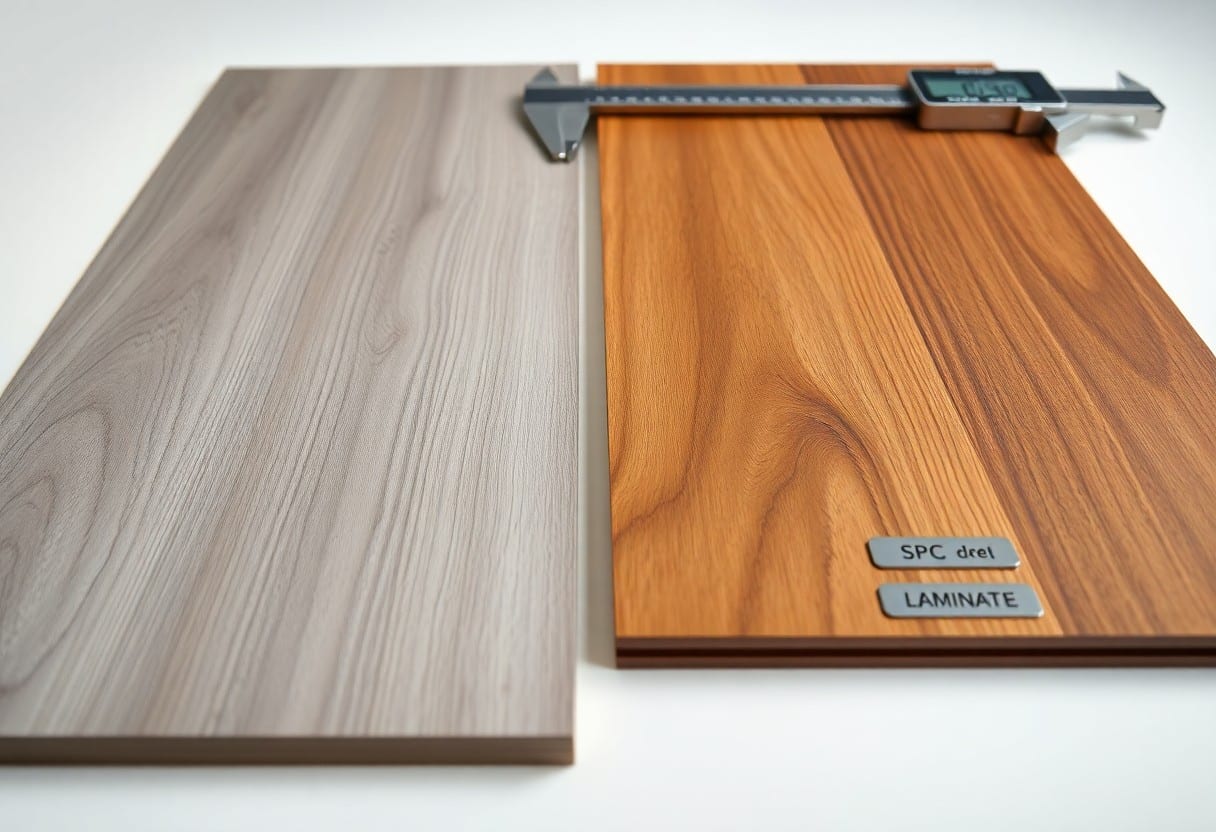
Most homeowners like you must decide between SPC vinyl and laminate flooring; this guide compares durability, moisture resistance, installation, and cost to help you choose the best fit for your rooms and budget.
Core Composition and Structural Integrity
Structure determines how each flooring handles weight and moisture; SPC uses a dense mineral core that resists warping, while laminate relies on HDF which swells with water unless sealed. You should weigh load-bearing and moisture exposure when choosing.
SPC: The Stone Plastic Composite Advantage
SPC’s stone-plastic composite core gives you superior rigidity and excellent water resistance, letting you install on concrete or below-grade areas without worry. You get long-term dimensional stability and minimal expansion under temperature changes.
Laminate: High-Density Fiberboard Dynamics
Laminate’s high-density fiberboard core delivers good strength and affordability, but you must protect it from moisture since HDF can swell and delaminate if exposed. Choose proper underlayment and moisture barriers for wet areas.
When evaluating laminate, understand HDF is manufactured from compressed wood fibers bound with resin; higher density improves wear resistance but reduces moisture tolerance. You should compare AC ratings, core thickness, and manufacturer warranties to match traffic and household conditions.
Water Resistance and Moisture Performance
Water exposure separates SPC and laminate by design: SPC delivers full core protection while laminate resists surface spills but suffers if moisture reaches the HDF core. You should consider room humidity, spill frequency, and underlayment when choosing between them.
100% Waterproof Capabilities of SPC Vinyl
SPC is 100% waterproof at the core, so you can install it in kitchens, bathrooms, and basements without core swelling. You still need tight seams and proper installation to prevent moisture underlaps that could affect adhesives or subfloors.
Topical Water Resistance vs. Core Sensitivity in Laminate
Laminate offers topical water resistance through wear layers and coatings, but your HDF core swells when water penetrates seams or edges, making prolonged exposure risky. You should limit laminate to low-moisture rooms and address spills immediately.
When you choose laminate, look for water-resistant treatments and edge-sealed planks; these reduce short-term damage but won’t stop prolonged standing water. You should use vapor-barrier underlayment over concrete, maintain indoor humidity below 60%, and wipe spills within minutes. Professional installation with tight joints and beveled edges minimizes risk, and check manufacturer warranties for moisture exclusions before finalizing your decision.
Durability, Scratch, and Dent Resistance
Durability is a major factor: SPC resists scratches and dents better than laminate due to its stone-polymer core, while premium laminate with thicker wear layers can still perform well in low-moisture rooms – you should match material to household traffic.
Impact Protection of Stone-Based Cores
Stone-based cores absorb impact and resist permanent indentations, so SPC maintains its flat appearance under heavy furniture and pet claws; you’ll notice fewer marks over time compared with typical laminate.
Wear Layer Ratings and Surface Longevity
Wear-layer ratings help predict how long surfaces last under daily wear; you should choose higher AC or mil ratings for busy rooms, as thicker, tougher wear layers delay visible abrasion and preserve appearance.
Ratings let you compare protection: laminate uses AC grades (AC1-AC5) to denote durability class, while vinyl/SPC is measured in mils (commonly 6-20+ mil). You should aim for at least 12 mil or AC3 for general living areas and 20+ mil or AC4 for high-traffic homes; proper cleaning and felt pads under furniture extend surface longevity.
Visual Aesthetics and Design Authenticity
Visual authenticity shapes room character; SPC often shows sharper wood and stone details with steadier tones, while laminate can present more noticeable batch differences, so you can decide whether uniform realism or varied character fits your décor.
High-Definition Imaging and Embossed Textures
High-definition printing and embossed textures let SPC reproduce fine grain and tactile variation so you can experience convincing detail underfoot compared with basic laminate embossing.
Color Consistency and Plank Variation
Color consistency leans toward SPC for uniform rooms, whereas laminate’s plank-to-plank shifts can add a handcrafted, varied look if you want more natural irregularity.
You should inspect samples under your room lighting and order planks from the same production batch when matching large areas or future repairs, and if you prefer variation, mix cartons or stagger installation patterns to distribute color differences evenly across the floor.
Installation Methods and Subfloor Requirements
Installation varies: SPC tolerates uneven subfloors and allows direct laying over concrete or tile, while laminate needs flatter surfaces and often underlayment. You should check moisture and levelness before choosing, as laminate is less forgiving of imperfections and SPC handles slight irregularities better.
Click-Lock Systems and DIY Feasibility
Click-lock systems make both SPC and laminate easy to install without glue, so you can often DIY. You will need straight cuts, spacers, and basic tools; heavier SPC boards may require two people for long runs, but the process remains accessible for experienced DIYers.
Acclimation Needs and Surface Preparation
Acclimation matters more for laminate, which must sit in the room days to adjust to humidity and temperature; SPC is largely dimensionally stable but benefits from being conditioned to the space. You should clean and level the subfloor before installation.
When acclimating laminate, leave planks flat in the room for 48-72 hours with packaging removed and keep HVAC running at expected living conditions; consult the manufacturer’s recommended timeframe. You should measure subfloor flatness (typically within 3/16″ over 10 feet for laminate), test concrete moisture with a meter, and install a vapor barrier or underlayment if required. For uneven surfaces use a self-leveling compound, and remove old adhesives or loose boards so seams stay tight after installation.
Comfort, Sound Absorption, and Maintenance
SPC feels firmer underfoot than laminate, offering greater dimensional stability; you’ll find it cooler but easier to clean, while laminate can feel warmer with padding and demands more moisture caution.
Underfoot Feel and Thermal Conductivity
Laminate typically has a springier underfoot and higher thermal warmth; you can improve comfort with quality underlay that reduces cold transfer and fills minor subfloor irregularities.
Acoustic Performance and Cleaning Protocols
Consider that SPC’s dense core reduces impact noise, while laminate relies on underlay for sound control; you should follow manufacturer cleaning advice to protect surface wear and acoustic performance.
Noise transmission differs by construction and underlay: SPC’s rigid core blocks footsteps better, while laminate’s floating boards need thicker underlayment to approach similar decibel reduction. You should choose underlay rated for impact sound and follow installation tolerances to minimize gaps that amplify noise. Cleaning routines differ-use pH-neutral cleaners for SPC and avoid excess water on laminate; routine sweeping prevents abrasive grit from dulling finishes and altering acoustic coupling between boards.
Final Words
Presently you should choose SPC vinyl for moisture-prone areas and long-term durability, while laminate suits lower-traffic, budget-focused rooms; weigh water resistance, installation, comfort, and cost to decide which fits your home’s priorities.