Guide yourself through choosing between SPC, dry back, and laminate flooring with clear comparisons of durability, cost, installation, and upkeep so you can select the right option for your space.
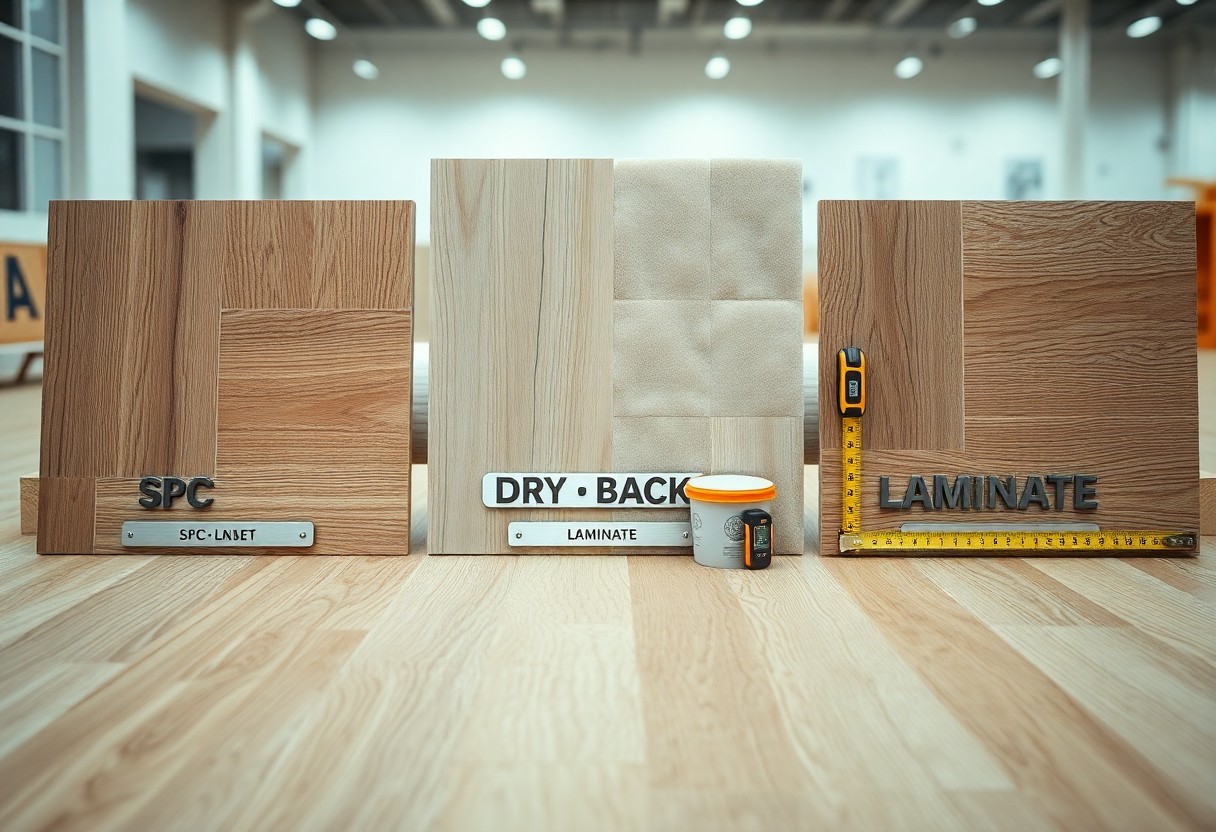
Crucial Factors for Material Selection
You should weigh moisture tolerance, subfloor prep, traffic levels, and installation complexity when choosing SPC, dry-back, or laminate; each material has trade-offs for cost, durability, and comfort.
- Assess moisture risks so you avoid swelling or adhesive failure.
- Compare durability and maintenance to match your lifestyle and budget.
- Any final decision should balance upfront cost with long-term performance for you.
Subfloor Condition and Preparation Requirements
Inspect your subfloor for levelness, moisture, and cleanliness; you’ll need leveling compounds for uneven surfaces and moisture mitigation for sensitive materials.
Environmental Humidity and Temperature Fluctuations
Monitor humidity ranges and temperature swings in the room; you’ll see SPC tolerates wider swings, dry-back prefers stability, and laminate risks warping if moisture varies.
Humidity Considerations
| Issue | Material Impact |
|---|---|
| High humidity | SPC tolerates moisture; avoid laminate without barrier. |
| Rapid temperature shifts | All floors need acclimation and proper expansion gaps. |
Control moisture by acclimating flooring 48-72 hours, installing vapor barriers where required, using HVAC or dehumidifiers, and leaving manufacturer-specified expansion gaps so your floor can expand without buckling.
Mitigation Strategies
| Strategy | Benefit |
|---|---|
| Acclimation | Reduces warping and installation stress. |
| Vapor barrier | Protects sensitive cores from subfloor moisture. |
| HVAC control | Keeps humidity and temp within safe ranges for you. |
Expected Foot Traffic and Wear Layer Thickness
Gauge expected traffic and select a wear layer thickness to match how you use the space; you should choose thicker wear layers for busy areas to extend lifespan.
Choose wear layer specifics: for light residential use 0.2-0.3 mm, for active homes aim for 0.5 mm, and for commercial or heavy wear select 0.7 mm or higher so you avoid premature wear and replacement.
To wrap up
On the whole you should weigh moisture exposure, foot traffic, budget, installation method, and appearance when choosing SPC, dry-back, or laminate; SPC resists water and heavy use, dry-back offers a solid tile base, and laminate gives affordable style and easy replacement.